

In-home and community support
Hours that fit the actual week. Time at home, for when being on your own is the hard part. Time out in it too: the gym, the boxing gym, a walk, a coffee, the appointment that keeps getting pushed back.
Registered NDIS provider · Working across Victoria
Jay’s Support Services is NDIS support for adults and young adults with complex histories, including people coming back into the community from custody. Our team has spent its working life doing this work. We build a small team around each person, we work alongside the people who matter to them, and then we keep that team there.
Where we came from
Jay’s Support Services was founded by Chernor Jalloh, known to everyone as CJ. He was born in Sierra Leone and grew up in Seattle, and he spent seven to eight years inside the American prison system working with young people aged 14 to 22 on getting out and staying out.
He came to Australia in 2021 and started at a disability agency in Melbourne. He kept being handed the people other workers were struggling to reach, and it kept working. A behaviour support practitioner he worked alongside told him he should be running his own service. Jay’s Support Services came out of that conversation.
That experience is the foundation the organisation was built on, and it set the standard the whole team works to. The niche was never a gap in the market. It was a set of skills worth building a service around.
Meet the team, and read the full story“You can’t fake this. People figure you out fast, especially the ones who’ve been let down before.”

What we do
Hours that fit the actual week. Time at home, for when being on your own is the hard part. Time out in it too: the gym, the boxing gym, a walk, a coffee, the appointment that keeps getting pushed back.
For most of the people we support, we coordinate as well. That means the care team meeting actually happens. The OT, the behaviour support practitioner, the lawyer and the family in one conversation, with someone in the room who sees the person every week.
Custody back into the community. Crisis accommodation to a front door of your own. Hospital back home. These are the stretches where support usually changes hands. We stay on.
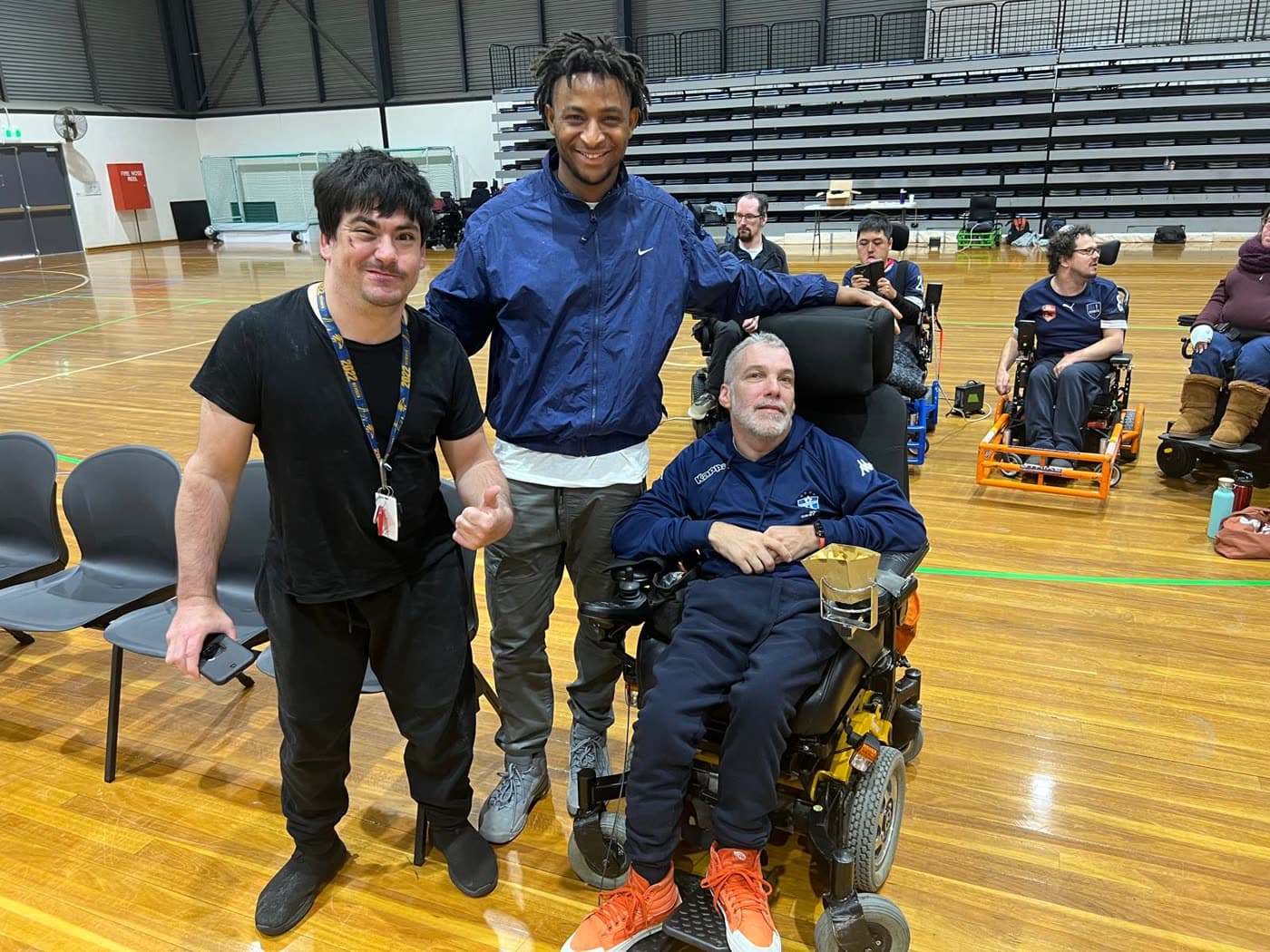
An ordinary week
Not a stock library. The gym on a Tuesday, the boxing bag, a powerchair football match on a Saturday. Taken on shift by the people who were there. If it is on this page, it happened.

In practice
Support work with a complicated history is a matching problem before it’s a rostering problem. We read the whole picture first. What happened, what sets a week off course, who the person actually responds to.
Then we choose from a small team, several of whom bring their own experience to it, and brief them properly on what they’re walking into. Then we hold that pairing steady, because the relationship is the part that does the work.
“You want to get to know their background first, instead of just throwing someone at them. If you don’t know how, how are you going to be able to help?”
The same three steps every time, whether someone’s coming out of custody or coming off a waitlist.
How we work
Support isn’t just sending a worker or completing a service. Where it’s appropriate, and always with the participant involved and consenting, we work alongside the people who matter to them: family, carers, and the professionals already in their corner.
That’s how a team comes to understand the whole person. The history, the strengths, the things that knock a week off course, what they’re actually working towards, and the environment they go home to. It’s also how we keep improving the support we give, rather than delivering the same thing every week and calling it consistency.
Where the participant wants them there, the people closest to them are in the conversation rather than updated after it. They usually hold the history nobody else has.
The occupational therapist, the behaviour support practitioner, the coordinator, the lawyer. We turn up to the care team meeting, and we turn up with something useful to say.
Nobody’s story gets shared around them. The participant decides who is involved and how much they hear, and that decision can change whenever they want it to.
What we’re working towards is the part that’s hard to write into a plan: more wellbeing, more independence, more stability, and a life that feels better to live.
For support coordinators, behaviour support practitioners, allied health and justice teams
Complex behaviours, a forensic history, a transition back into the community. This is the work Jay’s Support Services was built for, and our team was doing it long before the NDIS existed.
We’ll tell you on the call what we can take and what we can’t. You get the read before you build a plan around it, not three weeks in.
There’s no intake queue and no account manager. The person who takes your call is the person who does the assessment, and they’ll be at the review too.
Proof
Every participant who’s come to Jay’s Support Services has stayed. That’s the number we’re proudest of. Families stay close too. There’s a sit-down every week or fortnight about how the support is actually going, and what needs to change.
Next step
Whether you are looking for support for yourself or someone in your family, or you have a referral that needs a home, start here.